
Why Every Deal Stays On the Marketplace, and What the Record Actually Buys You
The rule is not that we gain nothing from your order staying here, because we do. It is that a private chat produces nothing anyone can act on. Here is where the contact check runs, what a violation costs, what 374 recorded violations look like, and two cases where the deal moved off-platform and nothing could be done.
Suppliers and buyers are not allowed to move a transaction off this site. That rule gets explained badly almost everywhere, including on the previous version of this page, so here is the version that survives being checked.
The honest reason first, because the usual one is false
This page used to say that keeping orders here is not about money, because we take no commission. Half of that is true: nothing is taken out of an order, and the price a buyer pays is the price the listing shows. But the platform does take a percentage when a seller withdraws their earnings, so more volume here does mean more revenue for us. Pretending otherwise would be exactly the kind of unfalsifiable reassurance this rule is supposed to protect you from. Withdrawing earnings has the actual figure.
So the argument is not that we are disinterested. The argument is narrower and it holds: when a deal happens in a private chat, there is nothing left afterwards that anyone can act on. Not us, not you, not the other party. That is the whole of it.
Where the check actually runs
The contact-detail check is not a line in the terms. It runs at seven points, and each one refuses the submission rather than quietly stripping the text:
- The description you write when opening a support ticket.
- The subject and the body of every reply in that ticket.
- The reason field on a dispute.
- Your shop name and your shop description.
- The message shown when a shop pauses ordering.
- A product's name and its description, when a seller creates or edits it.
A hit does three things at once. The submit fails. A violation is written against the account with the offending text stored. And an hour of cooldown is added, which is then enforced the next time that account tries to open a ticket, so the immediate cost is that you cannot get help for an hour.
At three recorded violations the account is set inactive automatically. There is no warning stage between the second and the third.
What 374 violations look like
The record is small enough to describe exactly. There are 374 recorded contact-policy violations across 165 accounts. 104 of those accounts have exactly one, which reads like someone typing a handle out of habit. 24 have two. And 37 are at three or more, meaning they crossed the deactivation line, with the heaviest single account at twenty eight.
270 of the 374 came from inside a support ticket, which is the interesting part: the most common place people try to move a deal off-platform is the conversation that exists because something already went wrong. The rest came from shop pages, listings and dispute reasons. By language the split is 270 English, 95 Chinese, 8 Russian and one Portuguese.
The messages themselves are rarely elaborate. Plenty are two or three words: a messenger name, or a request to verify by phone. Nobody writes a paragraph explaining that they are about to leave the platform. They just drop a handle, and the reason that matters is what happens next.
Two cases where it went wrong, and nothing could be done
Both of these are real and both ended the same way.
A buyer disputed on this site after being scammed somewhere else
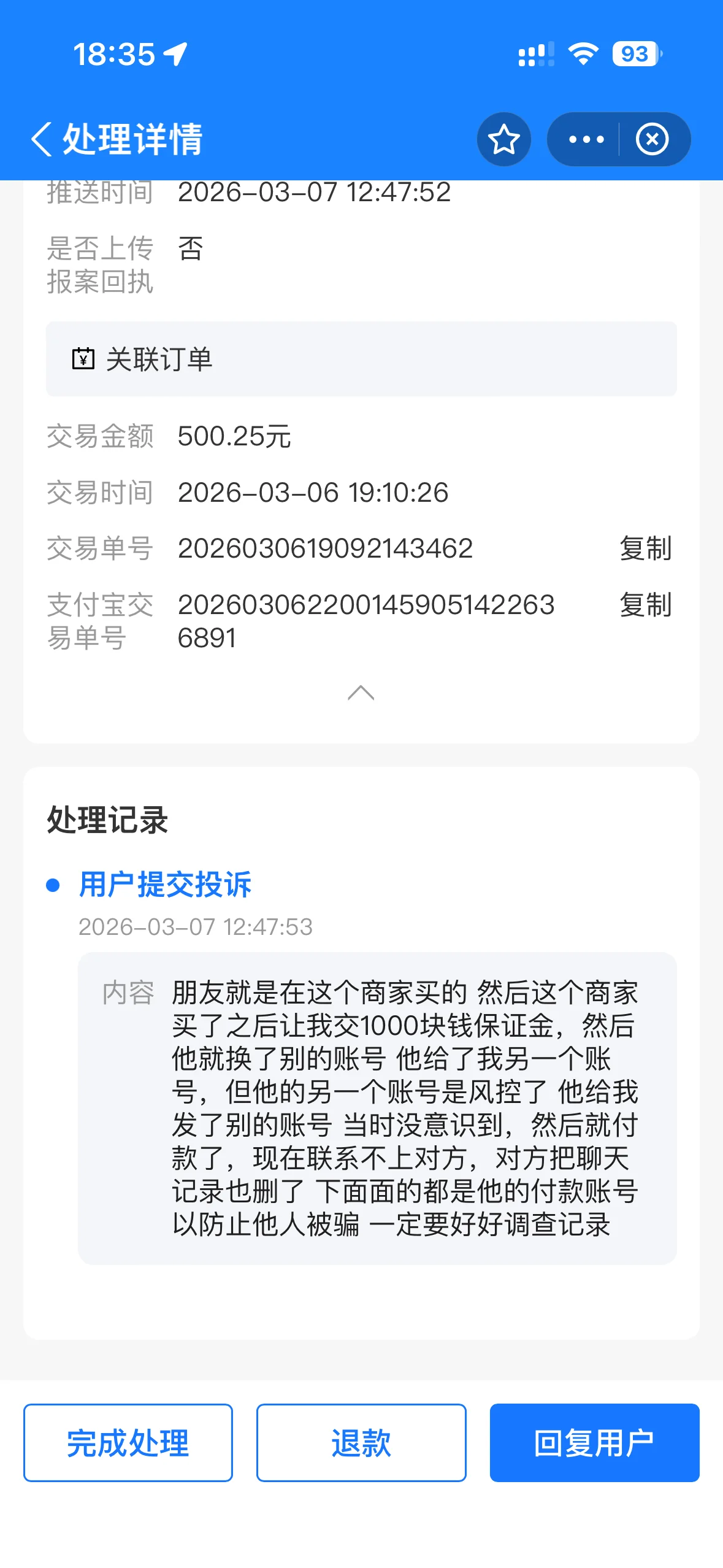
A client opened a dispute claiming a seller had taken a deposit and then cleared the chat so no proof survived. He wanted the money back.
Two details did not fit. This marketplace has no concept of a deposit paid to a supplier; every payment runs through the order. And nobody can delete a message in a ticket, so the history he described could not have existed here. What had actually happened was that the deal moved to a private messenger, the deposit was paid there, the scam happened there, and the dispute was filed here against unrelated earlier orders. There was no order record, no message trail and no payment to reverse. Nothing could be done.
A seller said he delivered; the buyer said he never received
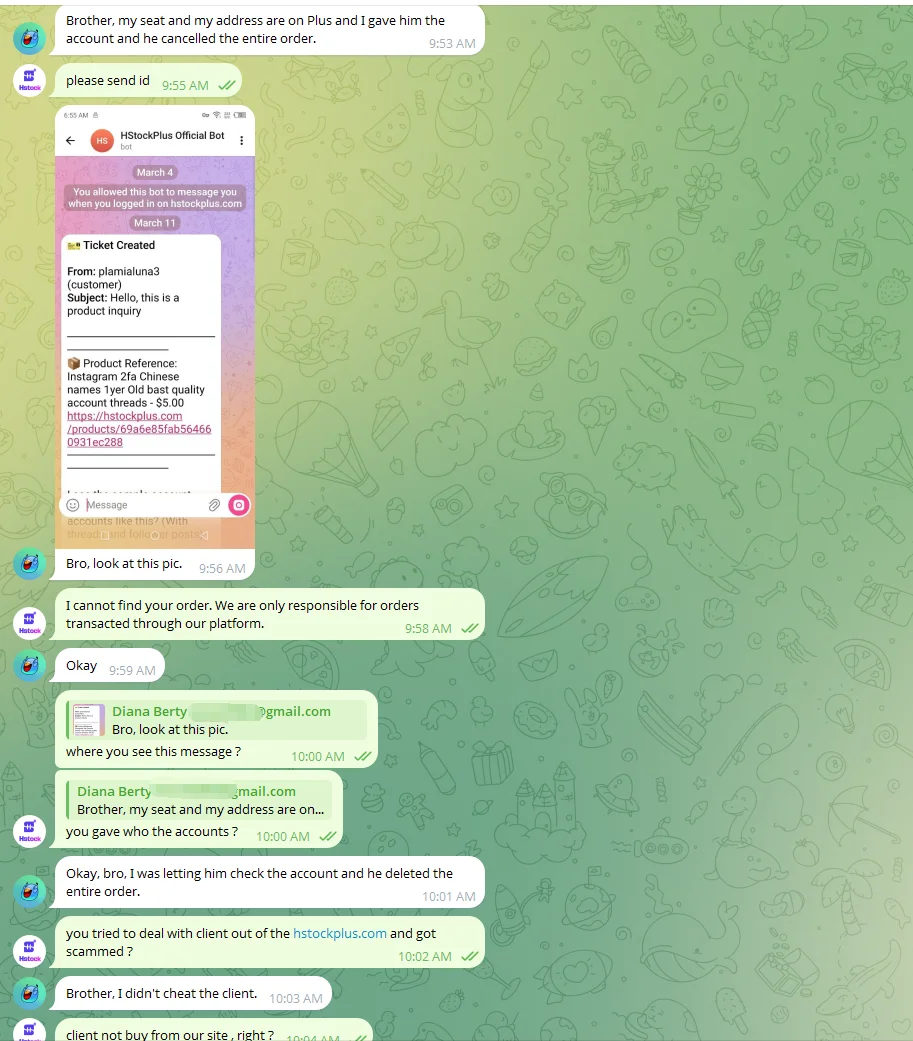
A seller reported that he had handed over accounts and never been paid. The buyer said the opposite. Checking the account showed the two had been dealing privately in a messenger. The delivery happened there and the payment was supposed to happen there.
There was no order, no record of what was sent, and no record of what was paid. Both people were certain and both were unverifiable. There is no fair way to decide that, so it was not decided.
What the record gives you that a chat cannot
Every one of these exists only because the order was placed here, and every one of them is a mechanism rather than a promise:
- Money that has not moved yet. Payment is held against the order rather than handed to the seller, and an open ticket stops it being released.
- A thread nobody can edit. One ticket carries the buyer, the seller and support, and messages cannot be deleted by anyone in it.
- A delivery record. What was sent, when, and how much of the order it covered, which is what a proportional refund is calculated from.
- A clock you can act inside. The warranty on the listing and the delivery due window both run automatically, without anyone agreeing to honour them.
- A refund path that does not need the other party's cooperation. On an undelivered order you can take it yourself.
The five clocks covers how each of those runs and what the site has recorded against them.
The smaller things you also give up
An order placed here can carry an automatic member discount, applied at checkout with nothing to claim; it was applied to 21,219 of 88,273 paid orders. Coupons ran on a further 5,041. Neither exists in a private chat. Sellers lose more: the order does not count toward their level, does not appear on their shop page, and cannot produce the cross-sales that come from a buyer landing on a storefront rather than a message thread.
If someone asks you to move the deal
Say no in the ticket, and do not repeat their handle back to them, because the check does not care who typed it and the strike lands on your account. Then finish the order here. If the counterparty will not deal on the platform, that is the useful information: the thing they are avoiding is the record, and the record is the only reason a stranger's promise is worth anything.
Where a shop is doing this systematically it gets suspended, and why we suspend shops for off-platform deals explains how that decision is made and what happens to the money.
Frequently Asked Questions
Because the deal then leaves the only place where anything can be proved. The check runs on ticket descriptions and replies, dispute reasons, shop names and descriptions, ordering-pause messages, and product names and descriptions. It refuses the submission rather than removing the text.
Three things at once: the submission fails, a violation is recorded against your account with the text stored, and an hour of cooldown is added that blocks you from opening a ticket. At three recorded violations the account is deactivated automatically, with no warning step in between.
There are 374 recorded violations across 165 accounts. 104 accounts have a single one, 24 have two, and 37 are at three or more. 270 of the 374 came from inside a support ticket, which is to say from a conversation that only existed because something had already gone wrong.
Yes. Nothing is taken out of an order itself, but a percentage is deducted when a seller withdraws, so on-platform volume is revenue for us. We would rather say that than argue from a disinterest we do not have. The reason to keep the deal here is the record it leaves, not our motives.
No, and not because of a policy choice. There is no order, no payment we can reverse, no delivery record and no message history. The only things we can act on are things the platform recorded, and a private conversation produces none of them.
Refuse inside the ticket, and do not quote their handle back to them, because the check flags whoever typed it. Then complete the order normally. A counterparty who will only deal off-platform is telling you what they are avoiding.
As a buyer: the held payment, the ticket thread, the delivery record, the warranty clock, the self-serve refund on an undelivered order, and any automatic member discount, which was applied to 21,219 of 88,273 paid orders. As a seller: the order does not count toward your level, does not build your shop page, and produces no cross-sales.