Seller Levels on HstockPlus: What Lv.1 to Lv.5 Actually Change
Five levels, set automatically by your rolling twelve-month sales. They move four things: how soon an order confirms itself, how many listings you may hold, how much stock you may keep available, and whether a dispute costs you a deduction. They do not move your ranking.
Michael Chen
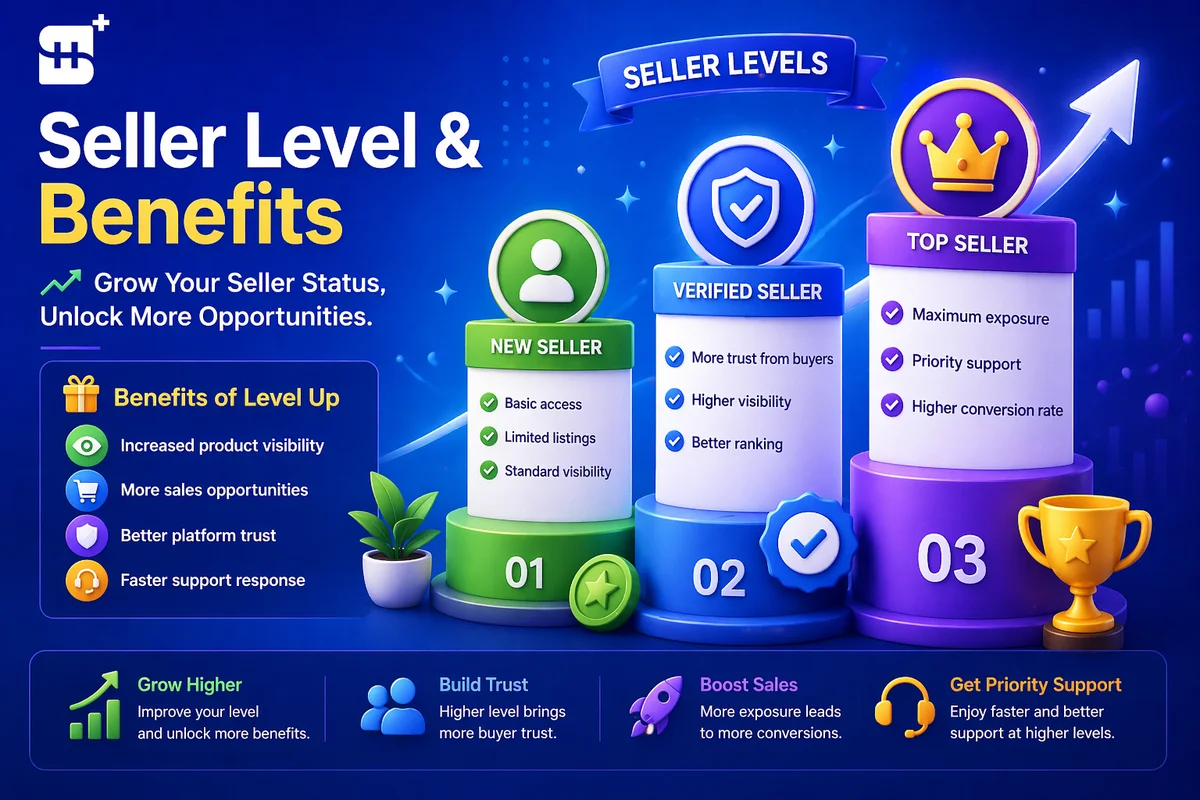
There are five levels, not three, and they are not called New Seller or Verified Seller. They are Lv.1 Member, Lv.2 Bronze, Lv.3 Silver, Lv.4 Gold and Lv.5 Platinum. Nothing is applied for and nothing is reviewed. Your level is read from your attributed sales over the trailing three hundred and sixty five days, so it can go down as well as up when an old month drops out of the window.
What follows is the whole list of things the level changes. It is shorter than most sellers expect, and the items on it are not the ones usually assumed.
The five thresholds and what each one moves
| Level | Sales in trailing 365 days | Auto-confirm wait | Listings | Available stock, per product / store | Dispute deduction |
|---|---|---|---|---|---|
| Lv.1 Member | from 0 | 3 days | 100 | 10,000 / 50,000 | applies |
| Lv.2 Bronze | from 1,000 | 3 days | 200 | 20,000 / 100,000 | applies |
| Lv.3 Silver | from 10,000 | 2 days | 500 | 30,000 / 150,000 | waived |
| Lv.4 Gold | from 20,000 | 2 days | 1,000 | 100,000 / 500,000 | waived |
| Lv.5 Platinum | from 30,000 | 1 day | 1,500 | 200,000 / 500,000 | waived |
If you have seen a different set of thresholds quoted, it came from a fallback table in the source that is only used when the configured one is missing. The configured one is what runs.
The auto-confirm wait, which is the one that pays you
A buyer who is happy usually does nothing. So an order that has been delivered and left alone confirms itself after the wait shown above, counted from when the order was placed. At Lv.1 that is three days; at Lv.5 it is one.
Confirmation is not a formality. It is the moment funds stop being held and become releasable to you, and it is also the moment those sales are attributed to your own rolling total, which is what sets your level. So the clock compounds: shorter wait, faster attribution, sooner the next threshold.
Two things stop the clock, and neither is affected by your level. An open ticket on the order suspends automatic confirmation entirely. So does an open dispute. Where an order carries products from more than one supplier, the longest wait among them is the one that applies to the whole order.
The listing cap, which binds on almost nobody
The cap is set per level in admin settings, not by a linear formula: one hundred at Lv.1, two hundred at Lv.2, five hundred at Lv.3, one thousand at Lv.4 and one thousand five hundred at Lv.5. It counts products only; growth-service listings are not counted against it and are not capped. Accounts marked as trusted have no cap at all, and support can raise an individual account's ceiling above the level table. The live numbers always sit on Seller levels & benefits.
It is worth knowing the number, and worth not organising your business around it. Of the four hundred and ninety supplier accounts currently holding any listing, twenty two hold a hundred or more. For everyone else the cap is a limit that has never been touched.
Available stock has its own ceiling, and it is the one you will hit
The listing cap counts products. A separate pair of ceilings counts inventory rows sitting in available state: one per product, one across your whole shop. Both are in the table above and both rise with level.
These bite in a way the listing cap does not, because they are checked at upload time. An upload that would push you past either ceiling is rejected outright with the remaining slots named in the error, rather than being trimmed. Rows already in the database stay deliverable; it is the next upload that fails. If you sell in bulk, this is the number to plan against.
The dispute deduction stops at Lv.3
When a buyer opens a dispute on an order, one per cent of your gross share of that order is set aside as a deduction, whatever the dispute later turns out to be. From Lv.3 upward the deduction is not applied at all.
This is the only level effect that touches money directly, and it is the reason Lv.3 is the meaningful step rather than Lv.2. Note what it is not: your withdrawal fee is a single global percentage and reads nothing about your level, so a Platinum account and a first-week account are deducted identically on payout.
Four promises this page used to make that the product does not keep
Earlier versions of this page said that levelling up brought higher visibility, better search ranking, priority support and a higher conversion rate. None of those is implemented. No ranking code, no catalogue placement code and no support routing code reads your level anywhere. The badge is displayed next to your shop and next to your name in a review, and that is the whole of its effect on how buyers encounter you.
There is one adjacent thing that is real, and it is worth stating precisely because it is easy to mistake for a placement benefit. Lv.1 through Lv.3 can earn a Top Pick slot and a free Telegram ad credit through the Share and Earn programme, subject to a weekly quota. From Lv.4 both are available without doing the programme and without the quota. The perk exists; it is the removal of a requirement, not a rank.
Where "Verified Seller" and "Top Seller" actually come from
Both phrases exist on the site, and neither is a level.
- Verified Seller is the placeholder name shown for a supplier inside a ticket thread when no display name is available. It is a label on a chat bubble. Nothing grants it and nothing is behind it.
- Top Seller is a flag an administrator sets on a shop to order the public shops directory. Five shops carry it. It is curated by hand and has no threshold, so no amount of sales produces it.
- New Seller does not exist anywhere in the product.
What the level distribution actually looks like
Roughly fifteen hundred accounts hold the supplier role. Around three hundred and thirty have any recorded sales at all. Fewer than fifty have passed the Lv.2 threshold on lifetime sales, and since the real test is a trailing twelve month window rather than lifetime, the number currently sitting at Lv.2 or above is smaller still. Single figures have cleared Lv.4.
That is not a discouragement, it is a calibration. If you are at Lv.1 you are with the overwhelming majority, the cap above you is one you are unlikely to reach, and the difference between you and Lv.2 is one day of nothing on the auto-confirm clock. The step that changes your economics is Lv.3, and it changes them by removing a deduction rather than by giving you an audience.