How Order Delivery Works on HstockPlus
Most orders here are filled without a seller touching them, and an order is never marked complete by hand: completion is worked out from what was actually delivered. Here is the real mechanism, with measured timings and what to do when nothing arrives.
 Sarah Johnson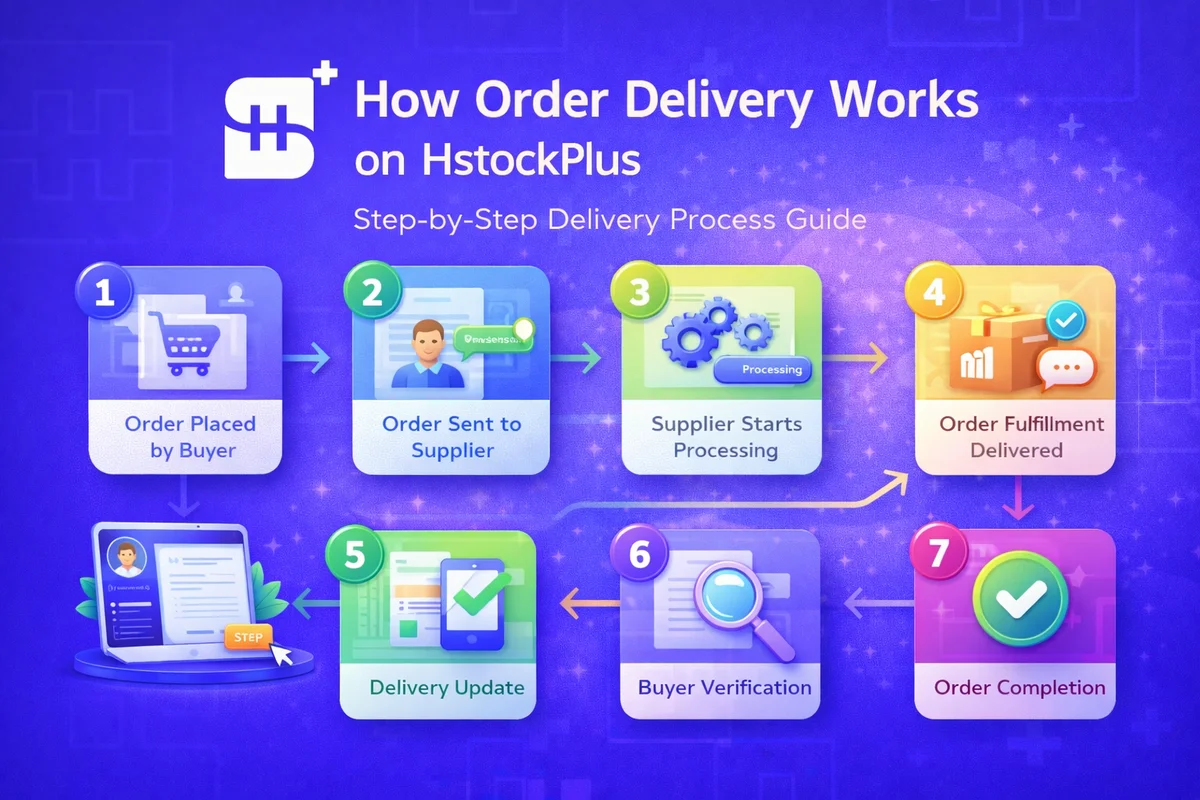
The short version: about five orders in six on HstockPlus are filled without a seller being involved at all, the median delivery lands in well under a minute, and no human ever marks an order complete. The system works out completion for itself from what was actually handed over. The longer version matters mainly for the minority of orders that do not go that way, so this page spends most of its length there.
Three routes, decided per order and not per listing
This is the part most descriptions get wrong, including some of ours. A listing does carry a delivery label, and on this catalogue every single listing carries the same one, which means the label tells you nothing about your particular order. What decides how your order is filled is a different property, and it is evaluated at the moment you buy.
- Automatic. Roughly seven live listings in ten. The seller has told the system it can always fill this, so it does.
- From inventory. Roughly two in ten. The seller has uploaded a pool of credentials in advance and the system takes what it needs from that pool.
- Made to order. Roughly one in ten. Nothing exists yet; the seller has to produce it.
And here is the consequence worth carrying away: the middle and last kinds behave like the first whenever the stock happens to be there. When you buy, the system counts the seller's actual available stock against every line of your order. If it covers you, the order is filled instantly with no seller involvement, whichever category the listing sits in. If it does not, the order waits for the seller. The same listing can therefore be instant for you today and a wait for somebody else tomorrow, and neither of you was shown anything different on the product page.
So the honest answer to "is this listing instant" is: usually, probably, and nobody can promise it in advance, because the answer depends on stock at the moment of purchase rather than on a setting.
What the buyer actually sees
- You pay. Balance, or a gateway callback confirming.
- The system checks stock. Immediately, against every line of the order.
- If stock covers it, credentials are reserved, marked as sold, attached to your order and shown on the order page. This is the common case and it is measured in seconds.
- If it does not, the order sits and the seller is notified. They deliver from their inventory or upload fresh credentials for it.
- The order completes on its own as soon as the delivered lines cover what you bought. Nobody presses anything.
- You check it and confirm, or let the clock confirm it for you.
Step five is worth dwelling on, because the old version of this page described a seller pressing a "mark completed" button and no such button exists. A seller has exactly two delivery actions available: deliver from the inventory they are already holding, or upload credentials for this order. Completion is not a claim they make; it is a comparison the system runs. Once the number of delivered account lines meets what the order needs, the order is complete. A seller cannot declare an order finished while it is short, and does not need to declare it finished when it is not.
How long it really takes
Measured across every completed order on the platform, timing the gap between payment and the first credential landing:
| Route | Typical | Slowest quarter starts at | Nine in ten by | Past 24 hours |
|---|---|---|---|---|
| From inventory | 1 second | 8 seconds | 2 minutes | 0.2% |
| Automatic | 40 seconds | 73 seconds | 3 minutes | 0.1% |
| Made to order | 34 seconds | 11 minutes | 8.5 hours | 2.0% |
Read the first column and the last one together, because that pairing is the real finding. The typical made-to-order delivery is as fast as the typical automatic one. Roughly thirty seconds either way. Sellers on this platform are mostly sitting on the stock they need even for listings that are nominally built per order, so the median tells you almost nothing about which route you are on.
The difference is entirely in the tail. On automatic and inventory orders the slow end is measured in minutes and effectively nothing runs past a day. On made-to-order the slow quarter stretches to eleven minutes, the slow tenth to eight and a half hours, and one order in fifty is still open a day later. That is a twentyfold difference in the odds of a long wait, sitting behind two medians you could not tell apart.
Across everything: about three quarters of deliveries land inside a minute, and nine in ten inside five minutes.
When nothing arrives
You are not stuck waiting for the seller, and you do not have to open a dispute to get out. There are two self-service exits, and neither is documented anywhere else.
Thirty minutes after payment, an order that has not been delivered shows a Request early refund button on the order page. Pressing it refunds the undelivered portion straight away. No ticket, no dispute, no waiting for anybody to respond. If your order was partly filled, only the unfilled part is refunded, which is the correct behaviour and also means you should not use it as a way to reverse a delivery you have already received.
A few conditions switch it off, and they are all sensible: it is gone once the order is fully delivered, once a dispute is open and unresolved, once the seller's funds are already in a withdrawal, and once you have used it on that order. Growth-service orders that are already processing are excluded too, because something is already in motion that cannot be pulled back.
Separately, sellers have a twenty-four hour window to deliver, and an order past it exposes a Request refund button on the same page. Same idea, longer clock, different rule.
Both of these refunds credit your site balance, which is the automatic route and what happens if you do nothing further. From there the money spends like anything else. If you would rather have it back where it came from, on the card, wallet or address you paid with, that is available too, but it is not something the button can do: you ask support and somebody processes it by hand. The reason it works that way is technical rather than obstructive. Several of the payment routes here cannot be reversed programmatically, and a crypto refund in particular has to be sent manually.
If what arrived is wrong rather than missing, these buttons are not the right tool. That is a dispute, and the warranty on the order is what governs it.
A number that should change how you shop, and one that should not
Should not: the route. Refunds run at roughly eight per cent on automatic orders, eight per cent on made-to-order and seven per cent on inventory. Within a percentage point of each other. Made-to-order listings are not riskier, they are just occasionally slower, and choosing a listing on delivery route alone is optimising the wrong variable.
Should: the wait. If you have somewhere to be, the tail is real and it belongs to made-to-order. If you need credentials inside the hour, buy from a seller holding stock. If a day is fine, the distinction barely exists.
For sellers
Two things follow from the mechanism above. First, holding real inventory is not just a convenience feature; it is what converts your listings from "the buyer waits for me" into "the buyer waits for nothing", per order, automatically, without you changing any setting. Second, there is no completion button to forget to press. Deliver the lines and the order closes itself. What you can get wrong is delivering fewer lines than the order needs, in which case the order stays open, looks unfulfilled to the buyer, and becomes eligible for a refund they can trigger themselves after half an hour.
Once delivery has happened, tracking your orders covers the status labels and what confirming actually does.