Threads Ads and Monetization: What Pays, What Does Not, and What the Dates Say
Threads ads were not new in 2026, and the creator bonus that people are searching for stopped paying in 2025 without an announcement. Here is the verified timeline, what the platform does and does not pay for, and what this marketplace measures about where the money on Threads is actually going.
 Avery Bennett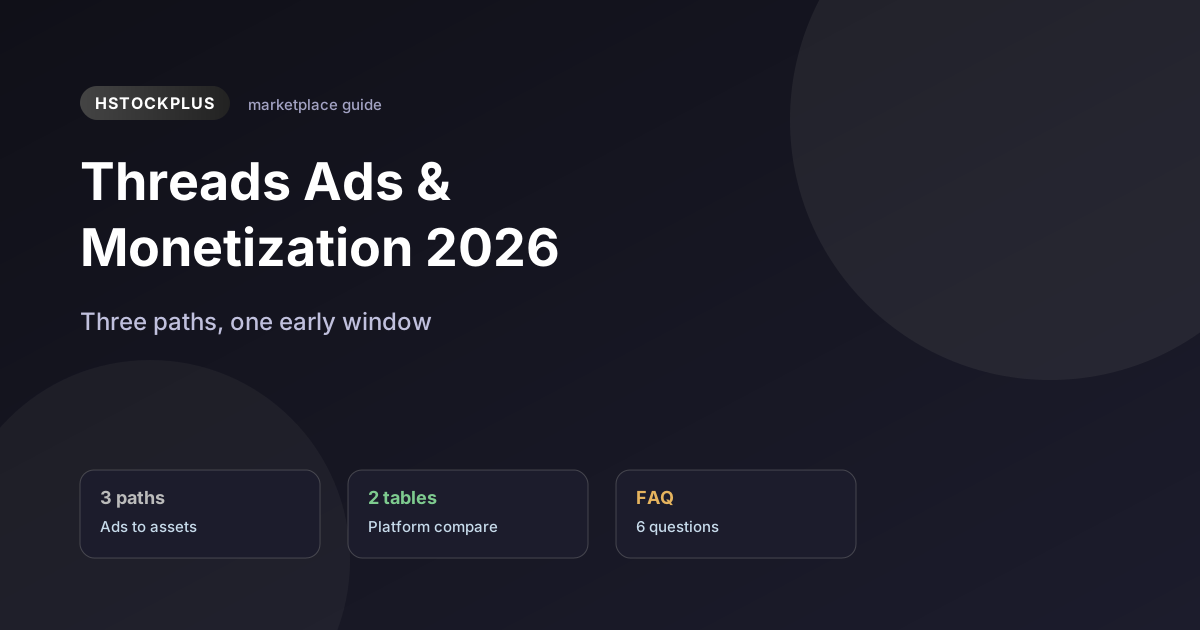
Two different people search this topic and only one of them was being answered. The advertiser wants ad specs and placements. Everyone else wants to know whether Threads pays them, and that is the larger group by some distance: the completions under "does threads pay" are creators, for views, for engagement, to post, and four of the ten under "threads monetization" name a country.
So the creator question first, because the answer is short and most articles do not give it.
Threads does not pay you to post, and the programme that did has stopped
Meta ran a bonus programme on Threads that paid selected creators for hitting post and view targets. It went to some creators and not to others, and no threshold was ever published that you could satisfy on purpose. Creators reported the payments stopping around the end of April 2025, roughly a year after it began, and it was reported that July. The company never explained it, and the Instagram support page that used to describe the incentives no longer mentions Threads at all.
Which means there is currently no open creator payout on Threads: no revenue share, no per-view rate, and nothing to qualify for. If you have searched for the requirements and found only articles listing them, that is because the requirement lists describe a programme that has stopped, and anything selling you access to it is selling access to nothing.
That is not the same as saying nobody makes money here. It means the money arrives from brands, from affiliate links, and from selling your own things, and none of those depend on Meta paying you or on which country you are in. The Instagram earning guide goes through each route, and it applies almost unchanged, because the routes are the same ones.
The ad timeline, since the whole "get in early" argument depends on it
Ads on Threads did not open in 2026. The sequence, from trade reporting rather than from any page Meta publishes, since those return errors to anyone who fetches them:
- January 2025. Testing begins with a limited set of advertisers in selected markets.
- April 2025. Opened to all eligible advertisers, though delivery stayed restricted by region. Coverage at the time called this the global rollout, which is where the confusion comes from: it was global for advertisers, not for users.
- Late January 2026. Ads expand to all Threads users worldwide, with Meta saying delivery would initially stay low while it reached full availability over the following months. At the same point it stated more than 400 million monthly active users, against 300 million in the April 2025 coverage.
Read against that, the "be early" pitch needs care. By the time most people read about Threads ads in 2026, the advertiser side had been open for close to a year. What was new in 2026 was that every user could be shown one, which is an inventory expansion rather than an open door.
And nobody can tell you what that inventory costs relative to anything else. There is no published rate card, the figures in circulation are agency estimates repeating each other, and this post prints none of them. What you can do is run a small campaign with Threads enabled as a placement and read your own delivery numbers, which is a real answer and takes days rather than an argument.
Do you still need an Instagram account?
Mostly yes, and not always. In May 2025 Meta confirmed it was testing profile creation by email address or phone number, without the Instagram login, with some users in the EU. That was a test in one region on that date, and it may have moved since.
The practical version: assume Threads runs through Instagram unless your own sign-up screen offers you something else, and check the screen rather than an article. If you are operating more than one presence, that assumption is the one that shapes everything, because the account you are really maintaining is the Instagram one underneath.
Where the money on Threads is actually going, measured here
This site sells both Threads accounts and Threads growth services, which makes it possible to say something concrete about demand rather than about sentiment.
On 31 August 2026 the Threads accounts shelf held 479 live listings from 102 sellers, against 2,134 Instagram account listings. Across all completed orders, the Threads shelf has moved 41,861 units and the Instagram shelf 22,901. Per live listing that is about 87 units against about 11, roughly eight times the throughput on a shelf a fifth the size.
One caveat, because it matters: two listings account for 89 per cent of those Threads units, so this is a shelf with concentrated demand rather than broad demand. The Instagram shelf is not concentrated in the same way. The comparison between shelves still holds; just do not read it as 479 sellers all doing well.
The other half of the picture is the one worth acting on. Threads growth services have sold fifteen completed order lines in total, across a live catalogue of 150 services. The engagement side of this platform is barely being bought at all here, while the account side is being bought in bulk. Whatever people are doing with Threads on this market, it is standing up presences rather than decorating them.
Two things the catalogue says that are worth using
- Engagement on Threads is expensive relative to Instagram. Comparing the same seller's own catalogue on both platforms, Threads likes cost between roughly three and five times what that seller charges for Instagram likes, and it holds on all five sellers stocking enough of both to compare. Followers do not behave the same way: that comparison runs in both directions depending on the seller, so there is no direction to report and none is reported here.
- The shelf is very quiet about Instagram. Given that Threads is entered through Instagram in most places, you would expect the listings to say what happens to the Instagram account underneath. Only 49 of the 479 mention Instagram anywhere in the title or the description, and only 9 in the title. The ones that do mention it are not dearer: on the two sellers with enough to compare they sit at roughly parity with that seller's own Threads median. Fewer than one listing in ten says anything about a mailbox either.
That second point is the buying advice, and it is unusual in that it costs nothing. The credential that decides whether a Threads presence is durable is the Instagram login and the recovery route attached to it, and the market is not charging extra for stating it, which means asking costs you nothing but not asking can cost you the account. The Threads listings here come from many independent sellers with formats stated per listing, and the Instagram listings sit on the shelf underneath it.
Running more than one presence
The mechanics have not changed and do not need numbers attached to sound sensible. Accounts that share an outbound address are trivially linkable, which is why independent addressing is the first thing to sort out and the part most people skip; the multi-account networking guide covers what that involves in practice. Content that is copy-pasted across profiles is the second obvious pattern, and varying it meaningfully costs more effort than any tooling saves.
The advice this post will not give you is how many accounts to run or how many to hold in reserve. The published version of this page quoted numbers for both and there is no source for either; they were somebody's guess, formatted as guidance. Size it against what you can actually maintain, which is the only constraint you can measure.
What is worth saying is that buying accounts is the cheap part and keeping them is not. If you want the general version of that argument before you spend anything, the buying checklist covers what to confirm before an order, and the Threads growth listings are here if you decide the engagement side is worth the premium it carries.
Frequently Asked Questions
Not at the moment. Meta ran a bonus programme that paid selected creators for hitting post and view targets, with no published threshold anyone could satisfy on purpose, and creators reported the payments stopping around the end of April 2025, roughly a year after it started. It was reported that July, Meta never explained it, and the support page that listed the incentives no longer mentions Threads. There is no revenue share, no per-view rate and nothing to apply for, so any article listing the requirements is describing a programme that has stopped.
Testing began in January 2025 with a limited set of advertisers in selected markets. In April 2025 it opened to all eligible advertisers, though delivery stayed restricted by region, which is why coverage from that month calls it a global rollout. Ads reached all Threads users worldwide in late January 2026, with Meta saying delivery would initially remain low. So 2026 was an inventory expansion rather than an opening, and the advertiser side had been open for close to a year by then.
Nobody can tell you, and the confident answers are the tell. There is no published rate card for Threads placements, the cost figures in circulation are estimates repeating each other, and no published duration exists for how long any early advantage on any platform lasts. What you can do instead of arguing about it is enable Threads as a placement on a small campaign you were running anyway and read your own delivery numbers, which is a real answer in a few days.
In most places yes, but it is no longer universal. In May 2025 Meta confirmed it was testing profile creation with an email address or phone number instead of the Instagram login, with some users in the EU. That was a regional test on that date and it may have moved. Assume Threads runs through Instagram unless your own sign-up screen offers you something else, and check the screen rather than an article.
Ask what happens to the Instagram account underneath, because in most regions that is what a Threads presence actually is. The market is strangely quiet about it: of 479 live Threads listings here on 31 August 2026, only 49 mention Instagram anywhere in the title or description and only 9 in the title, and the ones that do are not priced higher for it. Fewer than one in ten says anything about a mailbox. Since stating it carries no premium, asking costs you nothing and not asking can cost you the account.
It is dearer than the Instagram equivalent and almost nobody here buys it. Comparing each seller against its own catalogue, Threads likes cost roughly three to five times what that seller charges for Instagram likes, and that holds on every seller stocking enough of both. Followers show no consistent direction, so no claim is made there. Meanwhile the whole 150-service Threads growth shelf has fifteen completed order lines against nearly 42,000 units moved on the accounts shelf. The money on this platform is going into standing up presences, not decorating them.
There is no answer to this that is not somebody guessing, which is why no number appears here. Size it against what you can actually maintain, since that is the only constraint you can measure, and remember that buying accounts is the cheap part. What decides how long an operation runs is independent addressing, content that is genuinely different between profiles, and pacing that does not look like a script, none of which get easier by adding more accounts.
Avery Bennett
Social media consultant and growth hacker. Specializes in viral content creation and influencer marketing strategies for brands of all sizes.