X Premium Payment Declined: What You Can Actually Check
The decline message tells you nothing, and neither X nor your bank publishes the rule that fired. Here is the one question that splits the problem in two, the things worth checking before you retry, and why a proxy is not one of them.
 Sarah Johnson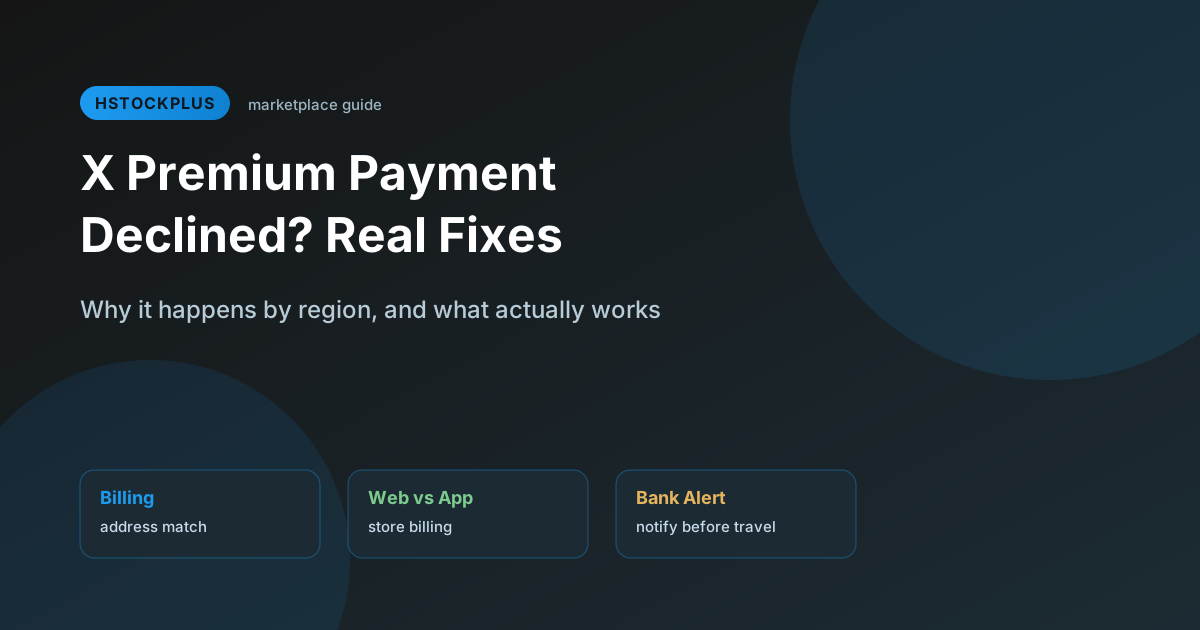
You try to subscribe or renew, and you get back some version of "we couldn't process your payment" with nothing else attached. The card is fine. You used it an hour ago.
The frustrating part is structural: nobody involved is going to tell you which check failed. X does not publish why a payment was refused. Your bank does not publish its fraud rules, and would not be doing its job if it did. Any page claiming to know that most declines have one particular cause is guessing, including the earlier version of this one.
What you can do is stop guessing along with them, because there is one question that cuts the problem in half.
Ask your bank whether they declined it
Call the number on the back of the card, or open the banking app, and ask whether an attempted transaction was refused. The answer puts you in one of two completely different situations, and almost nothing you read online is useful until you know which one you are in.
If the bank declined it, your problem is on their side, they can usually see a reason code, and they are the only ones who can clear it. This is the good outcome, because it is fixable by a phone call. Ask them to authorise the attempt and retry while you are still on the line.
If the bank never saw an attempt, the payment was stopped before it reached them, which points at the details on file rather than at fraud scoring. Then the list below is where to look.
Doing this first saves most of the wasted effort, because the two situations have almost no fixes in common and the decline message is identical in both.
Things worth checking, in no particular order of likelihood
These are ordinary causes of card refusals. Presenting them as ranked would mean inventing a ranking, so they are listed as things to verify.
- The billing address on file matches the card's registered address exactly. An address left behind after a move is a common and entirely silent cause.
- The country on the card matches the billing country on the account. A card issued in one country against an account region set to another is a mismatch nothing else will resolve.
- Foreign or international transactions are enabled. Many banking apps have this as a toggle, and many have it off by default.
- The card is not prepaid or virtual. Some issuers do not permit recurring charges on those at all, which produces a refusal that looks exactly like a fraud block.
- The bank knows you are travelling. A recurring foreign charge landing while your usual spending is somewhere else is the pattern fraud systems are built to catch.
- The card has not simply expired, which is worth thirty seconds because it is invisible in the error message.
Web checkout and the app stores are different payment paths
This one is genuinely useful and often overlooked. Buying through the website and buying through the iOS or Android app are not the same transaction. They go through different processors, so a card that fails on one can succeed on the other, and trying the alternative is a reasonable next step rather than a superstition.
Three practical differences follow from that. Which payment methods are accepted depends on the route, because through an app store it is whatever your Apple or Google account already has. The price and currency follow the billing address on the web and the store account region in an app. And cancellation lives wherever you subscribed, so a subscription bought in an app store has to be cancelled in that store's subscription manager, not in X's settings. That last one catches people out months later.
What does not work, including one thing we used to recommend
A VPN or a proxy will not fix this, and can make it worse. Changing the IP address the site sees does not change the country your card was issued in, and it is not part of the authorisation anyway: that happens between the merchant's processor and your bank, neither of which is looking at your browsing connection. Switching to a server in another country immediately before paying adds a mismatch rather than removing one. An earlier version of this page suggested a matching residential proxy might help here. That was wrong and we have removed it.
Services promising guaranteed activation regardless of card, region or bank. These generally want either your account password or to run the charge through a channel you cannot see. Handing over account access to route around a fraud check puts the account itself at risk, does not repair whatever mismatch caused the decline, and leaves you dependent on somebody else's payment method when the renewal comes round again. The underlying problem is still there and now somebody else has your credentials.
Retrying repeatedly. Several refused attempts in a row is itself a signal that pushes a risk score the wrong way. Fix something between attempts, or wait.
Where subscriptions and accounts fit here, plainly
We should be direct, because the previous version of this page was not. We do not sell X Premium subscriptions. There is a page for them on this site and no seller has ever listed anything on it, so pointing you there would have been sending you to an empty shelf. Nothing anywhere on the marketplace sells this subscription today.
What does exist is a different product, and it is worth knowing the difference. Out of more than nine hundred live X account listings, a handful, four at the last count, are accounts that already carry Blue. They are priced across a very wide range, spanning roughly a factor of twenty eight between the cheapest and the dearest, and the dearest of them is the single most expensive X account on the shelf. That range should tell you these are individual accounts with their own histories rather than a stocked product line.
It also comes with an obvious caution given the subject of this page: an account carrying an active subscription is carrying somebody else's billing arrangement, which is the exact failure mode you are currently reading about. If you go that way, check what the seller says about what happens at the next renewal before you buy, not after. The listings are on the X account listings page and what sellers disclose varies a lot between them.
A word on the word Premium, since it will confuse you otherwise. Around a sixth of our X account listings carry a tag reading Premium, and it does not mean X Premium. Those listings sit near the cheap end of the shelf, at roughly two thirds of the middle price, which is the giveaway. It is a quality adjective the sellers chose, nothing more.
Before you try the payment again
- You have asked your bank whether they declined it, and you know which of the two situations you are in
- The billing address on file matches the card exactly, including the country
- Foreign transactions are enabled in the banking app
- You have tried the other purchase route, web if you were in the app, app if you were on the web
- You are using a standard card rather than a prepaid or virtual one
- You have changed something since the last attempt rather than simply retrying
X's own help pages are the first-party reference. We could not read them from here, so we are not going to tell you what is on them. Your bank, on the other hand, will talk to you, and on this particular problem they know more than anyone else you can reach.
Frequently Asked Questions
Nobody publishes the answer. X does not disclose why a payment was refused, and banks do not publish their fraud rules. Anyone telling you that most declines have one specific cause is guessing. The useful first move is to ask your bank whether they declined an attempt, because that single question splits the problem into two situations with almost no fixes in common.
Simply whether an attempted transaction was refused. If they declined it they can usually see a reason code and can authorise a retry while you are on the line. If they never saw an attempt, the payment was stopped before reaching them, which points at the billing details on file rather than at fraud scoring.
No, and it can make things worse. Changing the IP address the site sees does not change the country your card was issued in, and your browsing connection is not part of the card authorisation at all, which happens between the merchant's processor and your bank. Switching to a server in another country just before paying adds a mismatch rather than removing one.
Try whichever one you have not tried. They are genuinely different payment paths through different processors, so a card that fails on one can succeed on the other. Just remember that a subscription bought through an app store must also be cancelled in that store's subscription manager rather than in X's settings.
No. There is a page for X Premium on this site and no seller has ever listed anything on it, and nothing else on the marketplace sells that subscription either. The nearest thing that exists is a small number of X account listings, four at the last count out of more than nine hundred, for accounts that already carry Blue, which is a different product with different risks.
Not X Premium. It is a quality adjective sellers apply to their own listings. Around a sixth of the X account listings carry it, and they sit near the cheap end of the shelf at roughly two thirds of the middle price, which is the clearest sign it is marketing language rather than a description of the product.
Treat them with suspicion. Bypassing a bank or regional check generally requires either your account password or a payment channel you cannot inspect. That puts the account at risk, does not repair the mismatch that caused the decline, and leaves you relying on somebody else's payment method at the next renewal, with the original problem still unsolved.
Sarah Johnson
Digital marketing expert with 10+ years of experience in social media strategy. Passionate about helping businesses grow their online presence through effective marketing techniques.