The Country on an X Profile Is a Guess, and X Says So
X shows two different location fields and labels its own output as possibly inaccurate. What "Account based in" and "Connected via" actually answer, why a VPN switched on today does not move either, and what that means for an account you bought.
 Sarah Johnson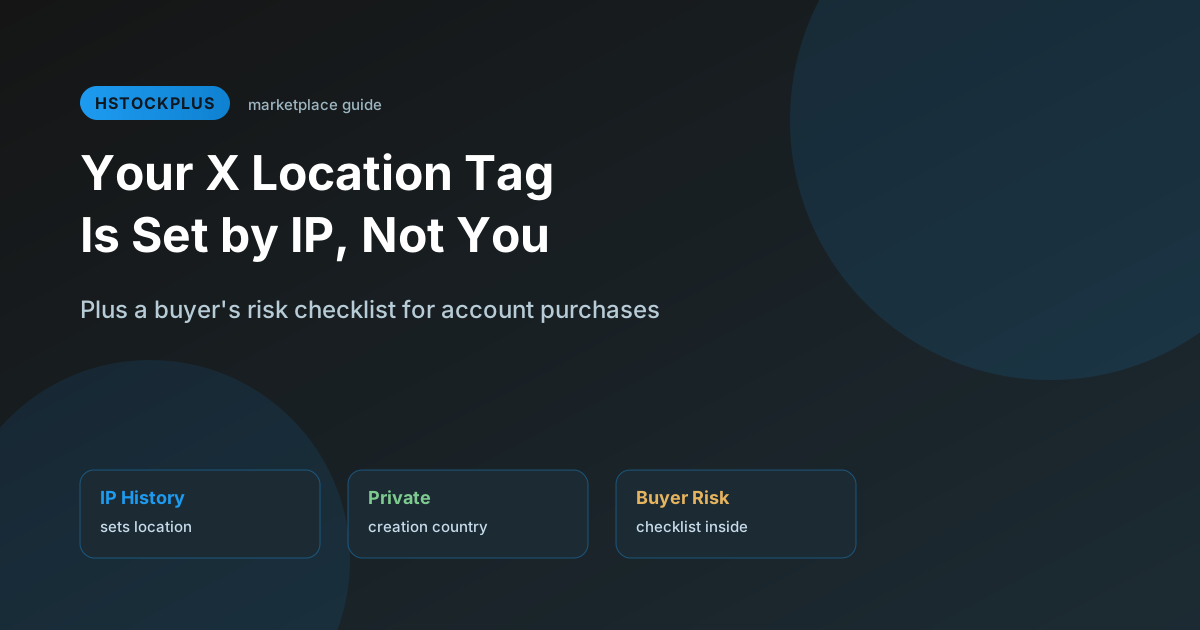
Since late 2025, X profiles carry a panel that reports where an account appears to operate from. It arrived without much explanation, it was immediately used to expose accounts posing as local voices in countries they had never connected from, and it has been generating arguments ever since.
Most of those arguments come from reading one line and stopping. The panel is not one line. It holds two different fields answering two different questions, and X attaches a warning to its own answer.
Two fields, not one
Open the panel on any profile and you will see them separately.
Account based in is an estimate of the country the account operates from. It is built from the account's connection history over time rather than from where it signed in this morning, which is the single most misunderstood thing about it.
Connected via reports how the account reaches X: through the web, or through a specific country's App Store or Google Play. It reflects where the app was obtained and the store region attached to it. This is why the two lines routinely disagree, and a disagreement between them is not a malfunction. An account can be based in one country and connected via another country's store because a phone was bought or an account was created somewhere else years ago.
If you searched for one of these and found writing about the other, that mismatch is the reason.
X labels its own output as possibly wrong
This is the part that changes how you should use the feature, and it is the part almost nobody quotes. X ships an accuracy note alongside the country: that it can be affected by recent travel or temporary relocation, that the data may not be accurate, and that it can change from time to time.
Take that seriously in both directions. It means an account showing a country you did not expect is not evidence of deception, and an account showing the country you did expect is not evidence of anything either. The label is an estimate presented as an estimate, and the platform that produced it is telling you not to lean on it.
So the honest use of the panel is as one weak signal among several. It is genuinely useful for the case it was built for, which is spotting an account whose stated identity and operating country are wildly apart. It is close to useless for deciding whether one specific person is who they say they are.
Why your VPN did not change it
This is the most common complaint and it has a simple explanation.
The estimate is built to favour long-running patterns over recent ones, deliberately, so that a two-week holiday does not relabel a resident of one country as a resident of another. That design choice is doing exactly what it was meant to do when it ignores your VPN.
The consequence is unwelcome if you were hoping to change the label. A connection you switch on today weighs almost nothing against months of history. The only thing that shifts a long-run estimate is a new pattern that is itself long-run, which is to say months of consistent use from one place. That is the opposite of what occasional VPN use looks like, and it means that switching connections frequently in order to move the label achieves the worst of both outcomes: the label stays unstable and you collect extra verification prompts on the way in.
There is no field anywhere in settings where you type your country, and there was never going to be, because a field you can type in would defeat the purpose of the feature.
What you can adjust, and why no click path is printed here
There are controls. What they let you do is reduce precision rather than remove the panel: showing a broader region in place of a specific country is the meaningful one, and it is worth knowing about if being readable to the country level is a professional problem for you.
This page does not give you the menu path to it. The feature's name and its position in settings have moved more than once since launch, and a click path written today would be wrong within months while still ranking. Open your own profile, find the section that displays account information, and read the options actually in front of you. Those are current by definition, which is more than any article can claim.
What this means for an account you bought
Here the label stops being trivia, and here are the parts that are specific rather than general.
The label will drift, and that is normal. A seller's screenshot showing one country does not come with the account. Once you use it consistently from somewhere else, the estimate follows you, on the same long-run logic that ignored your VPN. If you bought a country, you did not buy a country. You bought an account that currently displays one.
The store half does not drift. Where the app was obtained is a signal from the previous owner and you cannot retroactively change it. On a bought account, the connected-via line may keep pointing somewhere you have never been, indefinitely.
The label is not proof of age or of history. It reports a present-tense estimate. It cannot corroborate a claim about when an account was made or who has used it, and it should not be treated as verifying anything a listing says.
The recovery contact matters more than the country. Signing in from a new country is one of the more reliable ways to trigger a verification prompt, and the prompt goes to whatever contact details the account holds. On an account you have just bought, that is frequently still the seller. People spend the first day arranging a matching connection and lose the account anyway, because the code went somewhere else. Take over the password, the recovery email, the phone number, and the active session list first. The country can wait; the codes cannot.
What the listings here actually say about region
Measured on this site's own shelf rather than asserted, because it says something the general advice does not.
Of more than nine hundred live X listings, around one in seven names a country or flies a flag in the title. Those that specifically name the United States are the expensive end of the shelf, at roughly four times the median price. Region is the dearest single attribute here, dearer than a registration year and far dearer than two-factor, which costs nothing extra at all.
More useful is the opposite group. Around seventy listings state outright that the account has a mixed IP history, and those sit slightly below the shelf median. That is an honest disclosure and worth reading literally: it says the account has not been used consistently from anywhere. If your plan involves a settled operating region, a mixed-history account is the one product on the shelf that contradicts the plan on its own label. It is not a bad account. It is a badly matched one, and it is cheaper for a reason.
The general point is that region is the attribute you pay most for and the one that decays fastest under your own use. Paying a premium for a displayed country, then operating from elsewhere, is buying something you will spend the next several months erasing.
On matching your connection to the account
If you do want a settled operating region, a stable connection is the way to get one, and the honest framing is that it works slowly or not at all. It builds a new long-run pattern over months. It does not repaint a label this week, and any product sold on the promise that it will is selling something the mechanism does not do.
This site lists proxies, with one caveat you should have before clicking. The proxy category is small, roughly eighty listings from a dozen suppliers, and a little over a third of them are consumer VPN subscriptions rather than proxies. Twenty sit in the residential subcategory, and even there a quarter of the titles make no residential claim, two of them describing server IPs instead. Read the listing, not the shelf name. The proxy and VPN listings are worth a look on those terms rather than on a recommendation.
If you are buying an account, compare a few X account listings on what they state about mail access and delivery format, since those decide whether you can complete the takeover above at all, and note how short the fault window is: close to a quarter of listings here give you under an hour from delivery. If you would rather grow an account you already hold than acquire a new one, Twitter growth services are the other route.
And if all you came for was to understand a line on your own profile: it is an estimate, X says it may be wrong, and there are two of them.
Frequently Asked Questions
They answer different questions. Account based in is a country estimate built from the account connection history over time. Connected via reports how the account reaches X, either the web or a specific country App Store or Google Play, which reflects where the app was obtained. The two often disagree, and a disagreement is normal rather than a fault.
There is no field where you set it, and there was never going to be, because that would defeat the point of the feature. The estimate favours long-running patterns, so it only moves in response to months of consistent use from one place. What you can adjust is precision: showing a broader region rather than a specific country is possible, and you should read the options on your own settings screen rather than trust a written click path.
Because it is designed not to. The estimate deliberately weighs long-running signals above recent ones so that travel does not relabel an account. A connection switched on today weighs almost nothing against months of prior history. Switching connections repeatedly to try to move it produces the worst outcome available: the label stays unstable and you collect extra verification prompts when signing in.
X itself says it may not be. The feature carries an accuracy note stating the country or region can be affected by recent travel or temporary relocation, that the data may not be accurate, and that it can change periodically. Treat it as one weak signal. It is genuinely useful for spotting an account whose claimed identity and operating country are wildly apart, and close to useless for verifying one specific person.
The based-in estimate will drift toward wherever you actually use it, on the same slow logic that ignores a VPN. The connected-via line is different: it reflects where the app was obtained, comes from the previous owner, and you cannot change it retroactively, so it may keep pointing somewhere you have never been. In short, you bought an account that currently displays a country, not a country.
Not the region. Signing in from a new country is one of the more reliable ways to trigger a verification prompt, and that prompt goes to the contact details on the account, which after a purchase are frequently still the seller. Take over the password, recovery email, phone number and active session list first. Arranging a matching connection before you control the codes is how people lose accounts they have paid for.
No. It reports a present-tense estimate of where the account currently operates and carries no information about when it was created or who has used it since. It cannot corroborate anything a listing claims about age or history, and it should not be used as a verification step.
That the account has not been used consistently from any one place, which is an honest disclosure rather than a warning sign. Around seventy of the live X listings here say it, and they sit slightly below the shelf median price. Read it literally against your own plan: if you intend to operate from a settled region, a mixed-history account contradicts that plan on its own label.
Sarah Johnson
Digital marketing expert with 10+ years of experience in social media strategy. Passionate about helping businesses grow their online presence through effective marketing techniques.