À quelle fréquence publier sur Instagram ? Le nombre n'est pas la réponse
Neuf des dix choses que les gens recherchent après cette question y associent un résultat : grandir, gagner des abonnés, augmenter l’engagement. C’est là la vraie question, et elle a une meilleure réponse qu’un tableau de fréquence. Deux lectures dans votre propre compte la tranchent.
 Sarah Johnson
Search this question and watch what the suggestions do. They almost never stop at the question. They finish it: to grow, to gain followers, to increase engagement, as a business, to build a following. Nobody wants the number on its own. They want to know what a number buys.
Which is lucky, because the number does not exist. There is no published recommendation from the platform, in any document a reader can open, and every cadence chart circulating online was assembled by somebody working from their own accounts and generalising. What does exist are two readings inside your own account that answer the question you were actually asking.
Reading one: the hours your followers are awake
Those "best time to post" charts, Tuesday at 11, Thursday at 2, are the same problem in a different format. They were computed from somebody else's audience. Yours has its own time zones, its own working day and its own commute.
Your version is free and sits in your own account. Switch to a professional account, which does not affect your posts or followers, and the audience section shows follower activity broken down by day and hour. That chart is about your followers and nobody else's.
Two things people consistently get wrong when reading it.
- The peak is not the best slot. It is when the most of your people are looking, and therefore also when the most content is arriving in front of them. Publishing thirty to sixty minutes before the peak often works better, because the post has accumulated a little engagement by the time the crowd arrives.
- On a small account the chart is noise. With a few dozen followers you are reading the sleep schedule of a handful of individuals. At that stage pick one fixed slot and hold it, so that you have one fewer variable moving.
If your audience spans distant time zones the chart shows two peaks. Do not split the difference; the midpoint misses both. Pick the market you are actually writing for, schedule the main content there, and use stories to cover the other side.
Reading two: the share of reach that came from non-followers
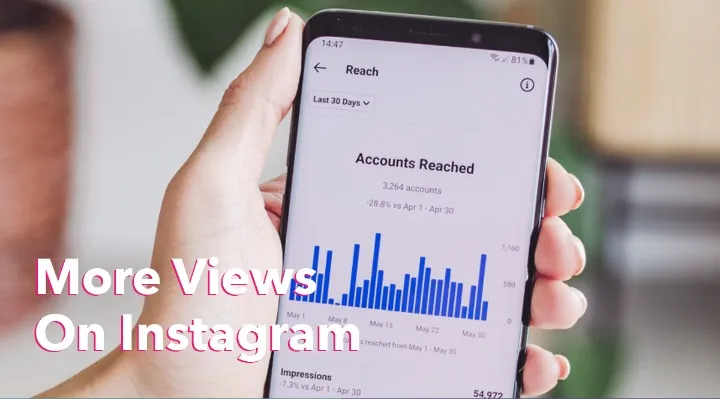
This is the one that tells you whether posting more will pay, and it is per post rather than per account. Each post's insights separate reach into people who follow you and people who do not.
- The non-follower share is rising. Your content is travelling outside your existing audience. Adding frequency has somewhere to land, and it is worth doing.
- The non-follower share is low and flat. You are circulating inside the same group. Posting more shows the same people more of you, which is how you get muted. The lever here is what you make, not how often.
- The non-follower share drops to nothing across everything at once, for weeks. That is not a cadence problem. Go and separate a restriction from a slowdown from something else before you spend another month adjusting your schedule; the shadowban guide is the right place for that.
This is a better instrument than a target frequency because it moves. A cadence table tells you the same thing in January and in June. This tells you whether the thing you did last week worked.
The test that decides the number: six months, not six weeks
When you do have to pick a figure, one criterion beats all the others. Can you hold it for six months?
Not one month. Six. Because distribution is evaluated on a rolling basis, and a run of posts is what gives the system something to work from. Three weeks on and two weeks off means restarting the accumulation every time, and, worse, it means you will attribute the two quiet weeks to being suppressed rather than to being absent. Then you start changing your captions, your covers and your format, and the one stable variable in the experiment is gone.
Three good posts a week for a year beats seven for a fortnight and silence afterwards, and this is not a motivational point. It is that the second pattern destroys your ability to read your own data.
Do not add the formats together
"How many times a week should I post" collapses three different jobs into one number, and the three cost wildly different amounts to produce. Sorting them by function is more useful than counting them.
| Format | What it is for | What limits it |
|---|---|---|
| Feed posts and carousels | Deciding whether a new visitor who lands on your profile stays | Your quality ceiling; this is the one to keep scarce and strong |
| Reels | The main route to people who do not follow you yet | Production time; worth protecting frequency here because the reach ceiling is highest |
| Stories | Staying familiar to people who already follow you | Almost nothing, which is why the quality bar is lower and the volume can be higher |
A single weekly total gives you no way to act on any of this. Two reels and one carousel is a completely different week from three carousels, for the same total.
Collab posts: one piece of content, two profiles
Worth knowing because it changes the arithmetic of frequency rather than adding to it. Invite another account as a co-author and, once they accept, the post appears on both profiles and shares a single set of engagement.
That is two distribution opportunities for the production cost of one. For a small account, one collab with a similar-sized account in the same subject usually returns more than three additional solo posts.
It does not work upward, though, and it is worth being clear why. The other party has to accept, and the post then lives on their profile too. A much larger account has no reason to carry a piece of content that is not theirs. This is a tactic between peers.
Filler is not free
The instinct when a schedule slips is to put something up anyway. The cost of that is not zero and it is not confined to the weak post. Distribution takes your recent run into account, so a post that lands flat affects the starting position of the next few.
Which means "post less, post better" is arithmetic rather than an aesthetic preference. If holding your cadence requires filler, the cadence is wrong and you should lower it.
The other half of holding a schedule is not relying on memory, and the platform's own scheduling now covers a good deal of what people used third-party tools for; the scheduler comparison covers where each still stops. For weekly themes, the hashtag guide is more use than a day-by-day list. And if you are running a launch and want a wider first wave on one specific piece, the Instagram growth listings here come from several independent suppliers with their terms shown per service, which is the only sane way to compare them. Attach that to your best post, never to the filler.