Développer ses abonnés Instagram de manière organique : sept actions, et la seule chose que l’argent achète vraiment
À travers quinze comparaisons au niveau des vendeurs sur cette place de marché, sans une seule exception, choisir d'où viennent vos abonnés est l'attribut qui coûte le plus cher. La croissance organique vous offre ce choix gratuitement, ce qui constitue un meilleur argument en sa faveur que tous les arguments habituels.
 Michael Chen
Two jobs sit underneath every account that grew without gimmicks: making things worth sending to somebody, and building a profile that converts a stranger's visit into a follow. Neither is fast and neither is clever. The search results promise something else, and the promise sells better than the work.
What is new here is a reason to prefer the slow route that does not rely on anybody's opinion about authenticity. It comes from the paid market, and it is unanimous.
The attribute every seller charges more for
This marketplace lists 4,453 live Instagram growth services from several independent supplier catalogues. Of those, 2,441 name a country or a region in the title, across eighty distinct region words. Among the 1,383 that sell followers, 881 name one.
Because everything is priced per thousand units, those can be compared directly, and because a shelf-wide average would only tell you which sellers stock what, the right comparison is each seller against itself. Take every seller holding at least five region-named follower listings and at least five untargeted ones, and compare their own medians.
Region-named costs more on seven sellers out of seven. Not most of them. All of them, at between roughly one and a half times and roughly seven and a half times that seller's own untargeted stock.
Run the same test on likes as an independent check and it holds again: dearer on eight sellers out of eight, with the gap running from about a third more to well over an order of magnitude. Fifteen comparisons, two metrics, no exceptions in either direction.
What that says is worth sitting with. The one thing the market prices as scarce is not volume, not speed and not durability. It is who the audience is. And an audience assembled around a subject you actually cover arrives sorted by definition, at no cost, in a way the market treats as the expensive option.
Seven moves, in the order they pay off
- Write the return in one sentence. People follow for something: a skill they can copy, a laugh, a look at something they cannot see elsewhere. Put it in one sentence with no clauses and no exceptions. Say it to somebody outside your subject; if they cannot repeat it back, it is not a sentence yet, and a feed that cannot be summarised collects an audience that cannot be described.
- Narrow until three posts explain you. Open your last twenty and mark the ones that belong to a different account. Cut them or move them to a second profile. The test is not whether you like them, it is whether a stranger landing on the grid can tell in three tiles what they are signing up for.
- Choose a rhythm you can hold for a year. Not a rate somebody else published. The right one is the one that survives a bad month, and the reason it matters has nothing to do with volume: an account posting on a schedule gives you a clean baseline, so you can tell which post did better. A scattered account gives you noise. The frequency guide covers how to find yours from your own account rather than from a table.
- Spend your tags on precision rather than size. A handful of slots, each pointing at a group of people who want that specific subject, beats a recycled block aimed at everybody. Broad tags with millions of entries put you in front of nobody in particular. The hashtag guide covers the current limit and how to choose within it.
- Comment where your future followers already read. List ten accounts your target follower opens in the morning. Leave comments that add something rather than agreeing with something, early enough to be seen. A reader who likes your comment taps your name, and that visit costs you no reciprocal favour and no deal.
- Rebuild the profile that converts the visit. Everything above delivers strangers to your profile, and the profile decides what happens next. The name field should carry your subject rather than repeat your handle, the first line should state the payoff rather than welcome anybody, the link should point somewhere connected to what you posted this week, and the top row of the grid should be the three posts that show the theme.
- Earn the first second of a video. Lead with the payoff, the question or the image that stops a thumb. This is the one step where you get immediate feedback: rewrite the opening line five times before posting and you will notice the difference in your own retention figures long before you notice it in your follower count.
Buy organic followers is a real search and a contradiction
It is one of the completions people actually type, which makes it worth answering rather than ignoring.
Nothing on any growth shelf is organic in the sense that matters here, because organic describes how the audience arrived rather than how the accounts behave. A delivery of followers who found you through no interest of their own is the opposite of the sorted audience the previous section priced. That is not a moral point. It is that you would be paying a premium for regional targeting to approximate, badly, a composition the slow route hands you for free.
The shortcuts that cost nothing fail in their own ways and they fail visibly. A free batch of followers arrives from accounts that opened your post for a reward, and you can watch the count drift back down over the following weeks without needing anybody to explain the mechanism. Follow-for-follow leaves a following list larger than your follower list, which is the first thing a visitor reads. Pods trade likes on a timetable between people who would otherwise scroll past. All three move a number. None of them changes who is on the other side of it.
One hard line regardless of route: nothing that requires your password or an active session should get either. A tool operating from inside your account acts as you, and the consequences land on you rather than on the vendor.
The readings that tell you sooner than the follower count
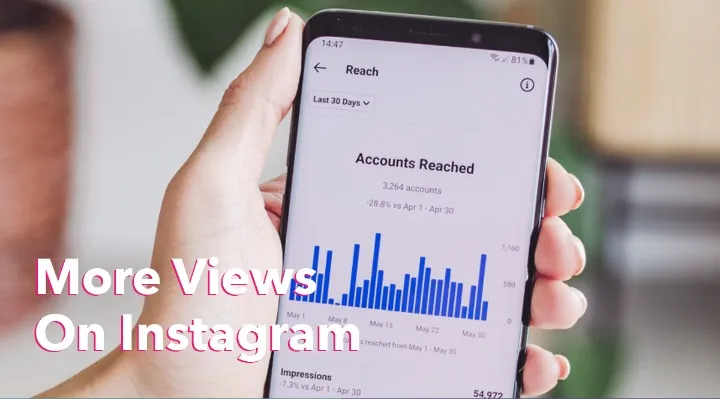
Follower count moves slowly and hides its composition, which makes it a poor steering wheel. Four readings in your own insights answer the question earlier, and all four are yours to check without buying anything.
| Reading | What a poor result points at |
|---|---|
| Follows produced by a single post | People arrived and did not stay. Work on the profile and the top row of the grid, not on distribution. |
| Share of viewers who did not already follow you | Thin discovery. Work on the opening line and the tags. |
| Saves and sends on a post | People consumed it and moved on. It needs something worth keeping or worth forwarding. |
| What the comments actually say | Emoji-only replies on post after post are the signature of a pod or of bought engagement rather than of an audience. |
Read them monthly rather than daily. One post tells you almost nothing and four weeks of posts tell you where the leak is. If reach falls across everything at once rather than on one post, that is a different problem and the account status checks come before any change of strategy.
Where a paid push actually fits
It does one job honestly: widening the first wave on something specific, or filling a profile that looks empty on the day a campaign starts. It cannot write your opening line, hold an audience through a slow month, or turn a follower into a buyer. An account that buys past a weak profile still owns the weak profile.
If you do test it, the useful comparison is what each listing commits to rather than what it costs, and the terms are on the card. The Instagram growth listings here come from independent suppliers with those terms visible per service, and the real-against-fake comparison covers what the difference in wording is actually worth. If you inherited a padded following rather than bought one, the removal guide covers the procedure.
Growth that holds looks dull from outside: one subject, a rhythm you keep, a bio that answers the visitor in a line, and comments you wrote yourself. Give the seven a full quarter, read the four signals monthly, and judge the method on what your own account shows you rather than on what a follower site promises.