Acheter un compte X : pourquoi le prix suit l’année, pas le nombre d’abonnés
Presque tout le monde qui cherche un compte X s’interroge sur les abonnés. Le catalogue ne tarifie pas du tout les abonnés ; il tarifie un seul pic à 2021. Voici ce qui fait réellement bouger le chiffre, et ce que auth_token et ct0 vous apportent.
 Avery Bennett
Search for this and the suggestions come back full of followers: with followers, with real followers, one thousand followers, followed by celebrities. That is what people want to buy.
It is not what the catalogue sells. Across nearly nine hundred listings there is no follower attribute in the pricing at all. What there is instead is one clean step, and it lands at 2021.
The only thing that really moves the price
Registration year splits this shelf into two tiers with a cliff between them, not a gradient:
- Registered before 2022: two bands, one up to 2016 and one from 2017 to 2021, together a little under half the shelf. Both cost about two and a fifth times the middle price. Same multiplier for both, which is why it reads as a step rather than a slope.
- Registered 2022 or later: about a quarter of the shelf, and slightly below the middle price.
So the practical question is not "how old" but "which side of 2021". Paying for a 2015 account over a 2019 one buys you nothing the market is charging for. Paying to cross from 2022 back to 2021 roughly doubles the price.
A word about "account age", which means something else in English
Worth flagging because the search results are misleading. Type "twitter account age" and what comes back is age checker, age verification, age restriction, age locked, age limit. Almost all of it is about how old the person is, under platform age rules, and none of it is about registration dates. "Aged twitter account" returns nothing at all.
If you are reading guides you found that way, check which sense they mean before you act on them.
What you are not paying extra for
Three things a first-time buyer expects to be upgrades are simply standard equipment here:
- Two-factor: on about seventy-one per cent of listings, at the middle price. No premium.
- A recovery mailbox: about sixty-five per cent, ten per cent above the middle. Barely a premium.
- Both together: fifty-four per cent of the shelf. It is the default configuration, not a package.
If a listing is priced up because it has 2FA and an email, you are paying for the norm.
The closest thing to what you actually asked for
Since followers are not priced, the nearest attribute is a filled profile: roughly thirty-eight per cent of listings, at half again the middle price. It is the second-dearest thing on the shelf after the pre-2022 tiers.
Read it for what it is. A filled profile means there is a picture, a bio and some history rather than an empty shell. It does not mean an audience, and no listing attribute on this shelf measures one. Where a listing does claim a follower count, that is free text from the seller rather than a catalogue field, so it is a thing to verify in your first minutes of access, not a thing to filter on.
auth_token and ct0, which is how you will actually log in
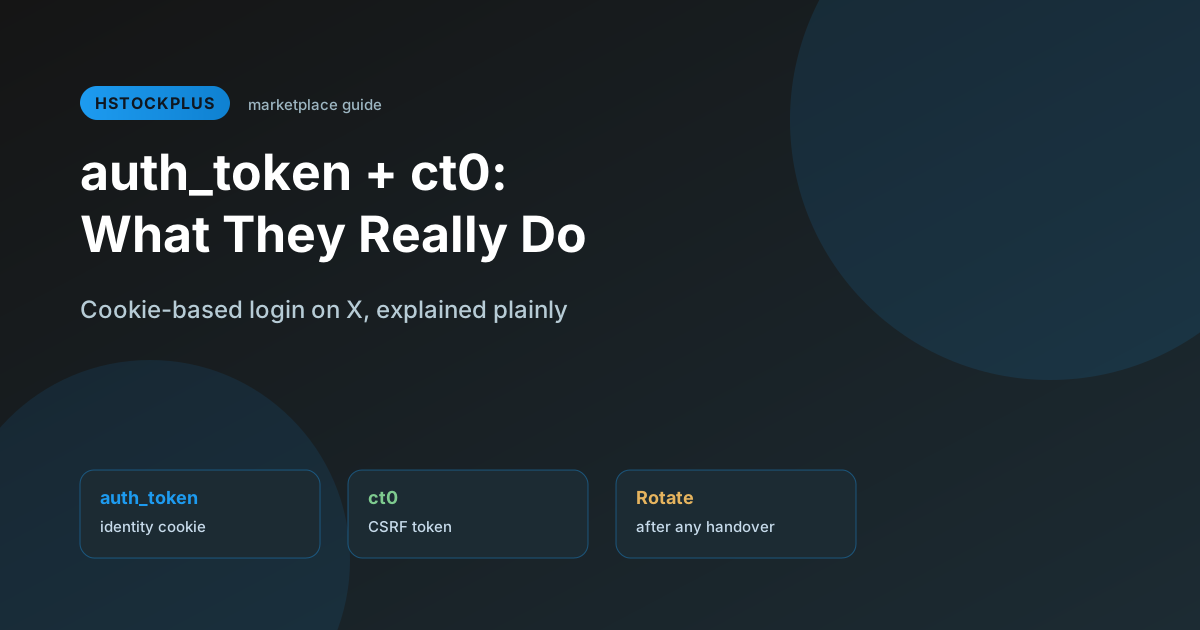
These two strings appear in most listings and they are session cookies, not a username and password. Tooling that supports cookie login uses them to connect as an already-signed-in user without going through a login screen.
Two consequences worth knowing. First, both are needed; one on its own usually fails, so check you received a complete pair before doing anything else. Second, cookies expire and can be invalidated by a password change, which is precisely why "check it works" has to happen immediately rather than next week. About twenty-nine per cent of listings carry a cookies tag explicitly, and they sit slightly below the middle price.
Shadowban claims, and what they can and cannot tell you
Listings sometimes advertise no shadowban or visible in search. Take that as a statement about the moment of sale. It is checkable then, and worth checking then, because visibility responds to what an account does afterwards and no seller controls that. A claim phrased as an ongoing guarantee is the wrong shape for what anyone can actually know.
This shelf is unusually competitive, which helps
Eighty-two suppliers, with the largest holding around thirteen per cent. That is the least concentrated shelf we measure, and it has a practical consequence: if a listing's terms look bad, there is almost always an equivalent one from someone else, so there is no reason to accept a listing you have doubts about.
Against that, about a quarter of listings arrive with a warranty window too short to be useful, and the median window is twelve hours with instant delivery. Filter those out before ordering rather than discovering it afterwards.
The first hour
- Confirm the auth_token and ct0 pair is complete and that your tool connects with it.
- Confirm anything the listing claimed as a number: follower count, tweet history, whether posts appear in search. All of these are checkable now and unarguable later.
- Confirm you can reach the two-factor settings and the recovery mailbox with what you were given, so you know the handover is complete.
Current stock, filterable by registration tier, profile completeness and verification, is on the X accounts shelf. Roughly seven hundred and fifty of the nearly nine hundred listings are in stock, so the constraint is choosing well rather than waiting for supply.